Roadmap
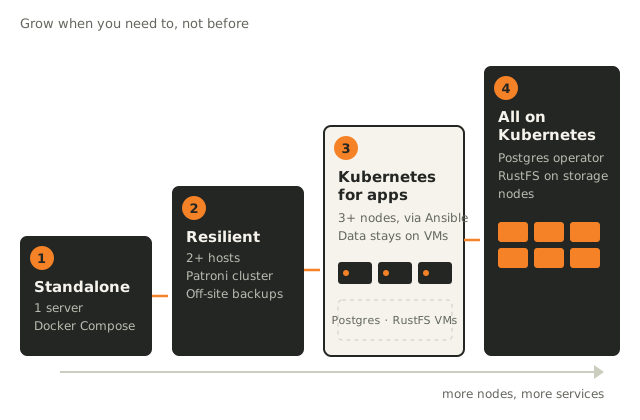
Four stages, built in order.
Most organizations will stop at stage 2 or 3, and that is fine. Each stage keeps the same repository and the same tools, so moving up is a planned step rather than a rebuild.
1
Standalone
One server or virtual machine, running everything with Docker Compose.
- OpenTofu and Ansible to build and harden the host
- PostgreSQL, RustFS and optional Valkey
- Nightly backups to RustFS, and an automatic test restore to prove they work
- A one-page status report
2
Resilient standalone
A second host, so one failure doesn’t mean days of recovery.
- PostgreSQL streaming replica on the second host
- RustFS on its own disks, with copies off-site, for example in a Tier III facility
- A written, tested failover runbook
3
Kubernetes for applications
Applications move to a small cluster. Databases and storage stay on their own virtual machines, where they are easiest to run.
- RKE2 or k3s, installed and upgraded by Ansible
- Applications deployed from Git with Helm charts
- Load balancing and certificates for an on-premise network
4
Everything on Kubernetes
For larger platforms where running data services outside the cluster becomes the bottleneck.
- PostgreSQL run by an operator, restored from the same backups as stage 1
- RustFS on dedicated storage nodes
- Scheduling for GPU workloads
Across every stage.
Routine checks
Restore tests, patching with a test group first, certificate and disk checks, and drift detection.
Works offline
Local mirrors for packages, container images and OpenTofu providers, for networks without internet access.
Compliance evidence
Configuration evidence saved automatically on every run and mapped to the controls it supports.
Hardware setup
Server firmware and BIOS settings through Redfish, before the operating system is installed.
In designbeing specified and built nextPlannedcommitted, after the stage before itExploringbeing evaluated, may change
Last updated 25 October 2026.